



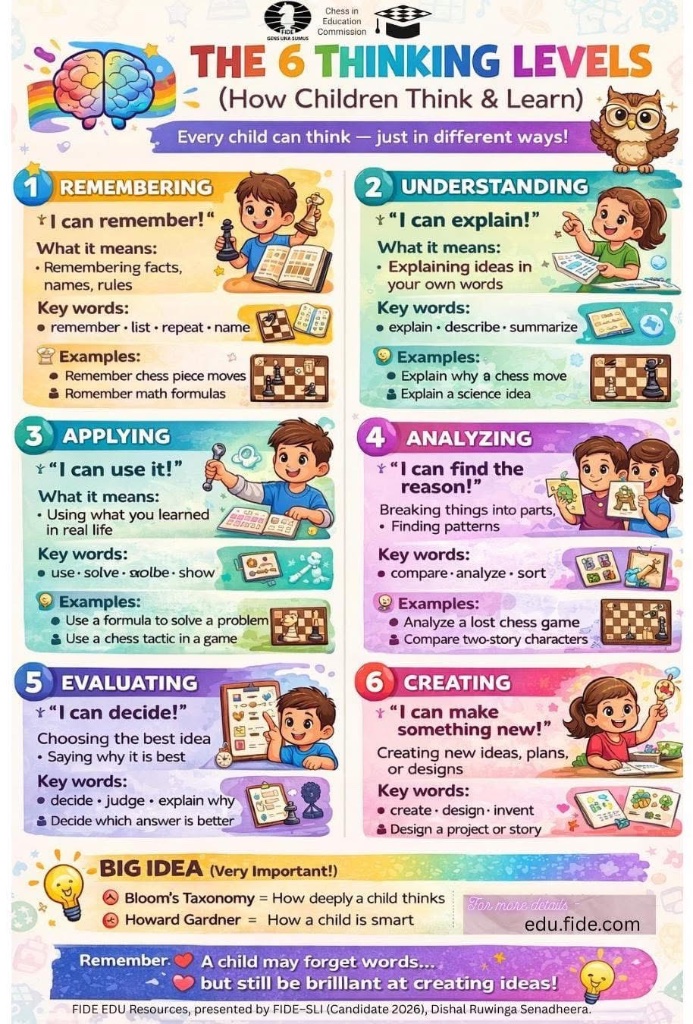
This educational framework beautifully illustrates the six levels of thinking, inspired by Bloom's Taxonomy, and shows how chess naturally supports each stage of a child's cognitive development.
## The Six Thinking Levels in Chess
### 🔹 1. Remembering "I can remember!"
- Recalling rules, chess piece moves, and basic patterns
- Remembering facts, names, and fundamental principles
- Key actions: remember, list, repeat, name
- Example: Remember how each chess piece moves
### 🔹 2. Understanding
- Explaining chess ideas and strategies in one's own words
- Describing concepts and summarizing learning
- Key actions: explain, describe, summarize
- Example: Explain why a chess move is strong
### 🔹 3. Applying
- Using learned concepts during real chess games
- Applying knowledge in practical situations
- Key actions: use, solve, show
- Example: Use a formula to solve a chess problem
### 🔹 4. Analyzing
- Breaking chess positions into parts and finding patterns
- Comparing strategies and analyzing game outcomes
- Key actions: compare, analyze, sort
- Example: Analyze a lost chess game to understand mistakes
### 🔹 5. Evaluating
- Making decisions and justifying the best choice
- Judging between different moves and explaining why
- Key actions: decide, judge, explain why
- Example: Decide which chess move is better and explain
### 🔹 6. Creating
- Designing new ideas, plans, and chess solutions
- Creating original strategies and approaches
- Key actions: create, design, invent
- Example: Design a creative chess project or opening strategy
---
## Why This Matters for Chess Education
♟️ Through chess, children don't just memorize — they explain, apply, analyze, decide, and create.
It nurtures critical thinking, problem-solving, and creativity, while respecting that every learner shines in their own way.
### ✨ The Big Idea:
📚 Bloom's Taxonomy = How deeply a child thinks
🧠 Multiple Intelligences = How a child is smart
### ❤️ A child may forget words... but still be brilliant at creating ideas!
This framework demonstrates that chess is more than a game — it's a powerful educational tool that develops higher-order thinking skills essential for 21st-century success.
---
## Chess as a Complete Learning Tool
By engaging all six levels of cognitive development, chess provides:
✅ Foundation skills through remembering and understanding
✅ Practical application through real game scenarios
✅ Critical thinking through analysis and evaluation
✅ Innovation through creative problem-solving
Every chess lesson at African Chess Lounge is designed to help students progress through these thinking levels, building not just chess skills, but life-long learning abilities.
---
*Educational framework based on Bloom's Taxonomy and adapted for chess education by FIDE Education Commission.*
#ChessInEducation #FIDEEDU #ThinkingSkills #21stCenturySkills #EducationThroughChess #BloomTaxonomy